







The Netdata Cloud MCP Server is now available — giving AI agents and assistants direct access to your Netdata through a single endpoint at app.netdata.cloud/api/v1/mcp.
AI Is Changing How We Monitor Infrastructure
If you’re an engineer in 2026, chances are AI is already part of your daily workflow, whether that’s a general-purpose assistant like ChatGPT, Claude, or Gemini that you bounce questions off, or a coding agent like Claude Code, Codex, Cursor, or Windsurf that writes and debugs code alongside you. These tools are incredibly powerful, but until now, they’ve been blind to what’s actually happening on your infrastructure.
That’s where MCP comes in. The Model Context Protocol lets AI tools reach beyond chat and code and interact with live systems. And with the Netdata Cloud MCP Server, they can now see your entire infrastructure — metrics, anomalies, alerts, logs — in real time.
Ask Claude or ChatGPT to analyze your fleet-wide performance trends. Use Gemini to summarize overnight alerts across all your nodes. Or debug a performance regression in Claude Code without ever switching to a dashboard, just ask: “What’s the memory and CPU profile of the API service across all production nodes right now?” and get a real answer, grounded in live data.
From One Node to Your Entire Infrastructure
Last year, we introduced MCP support in the Netdata Agent letting you connect AI assistants directly to individual nodes for real-time troubleshooting. The response from the community was incredible. Teams started having actual conversations with their monitoring data, asking questions in plain English and getting answers grounded in real metrics.
This was always intented as a first step and not a solution for infrastructure-wide monitoring and observability. That’s exactly what the new Netdata Cloud MCP Server is built for.
Agent MCP vs. Cloud MCP — What’s Different?
The Agent MCP Server is built into every Netdata Agent and Parent. It’s free, open-source, and gives you direct access to that node’s data. It’s perfect for local development, air-gapped environments, and quick single-node troubleshooting. Nothing has changed here — it’s still available on every Agent running v2.6.0+.
The Cloud MCP Server operates at a completely different level. Instead of connecting to one node at a time, you connect to app.netdata.cloud/api/v1/mcp and get access to every node in your infrastructure through a single endpoint.
Here’s what that means in practice:
| Agent MCP | Cloud MCP | |
|---|---|---|
| Scope | Single node or Parent | Your entire infrastructure |
| Best for | Local debugging, air-gapped environments | Fleet-wide operations, incident response |
| Cost | Free (all plans) | Business plans |
Why Infrastructure-Wide MCP Changes Everything
Ask questions without knowing the topology
With Agent MCP, your AI assistant needs to know which node to query. During an incident at 3 AM, that means you still need to figure out where the problem is before you can start investigating it.
With Cloud MCP, you just ask: “Which nodes are showing high CPU usage right now?” or “Are there any anomalies across my Kubernetes cluster?” — and the Cloud routes the query to the right nodes automatically. You don’t need to know the topology. The AI doesn’t need to know the topology. You just ask the question.
Correlate across your entire fleet
When a cascading failure ripples through your infrastructure, the root cause is rarely on the node that’s screaming the loudest. Cloud MCP lets AI assistants correlate anomalies, metrics, and logs across all your nodes simultaneously — connecting the dots across services, regions, and cloud providers that would take a human team hours to piece together.
One endpoint for everything
No more configuring separate MCP connections for each Parent or Agent. Whether you’re running 10 nodes or 100,000 nodes, it’s the same endpoint, the same token, the same experience. Connect your AI assistant once, and it can see everything you can see in Netdata Cloud.
Your data stays yours
A key concern with any cloud-mediated AI workflow is data sovereignty. The Cloud MCP Server works as an intelligent query router — it distributes your queries to the appropriate Agents and streams results back. Your metrics and logs are not stored in the Cloud. The same security posture you rely on with Netdata Cloud applies here.
Getting Started
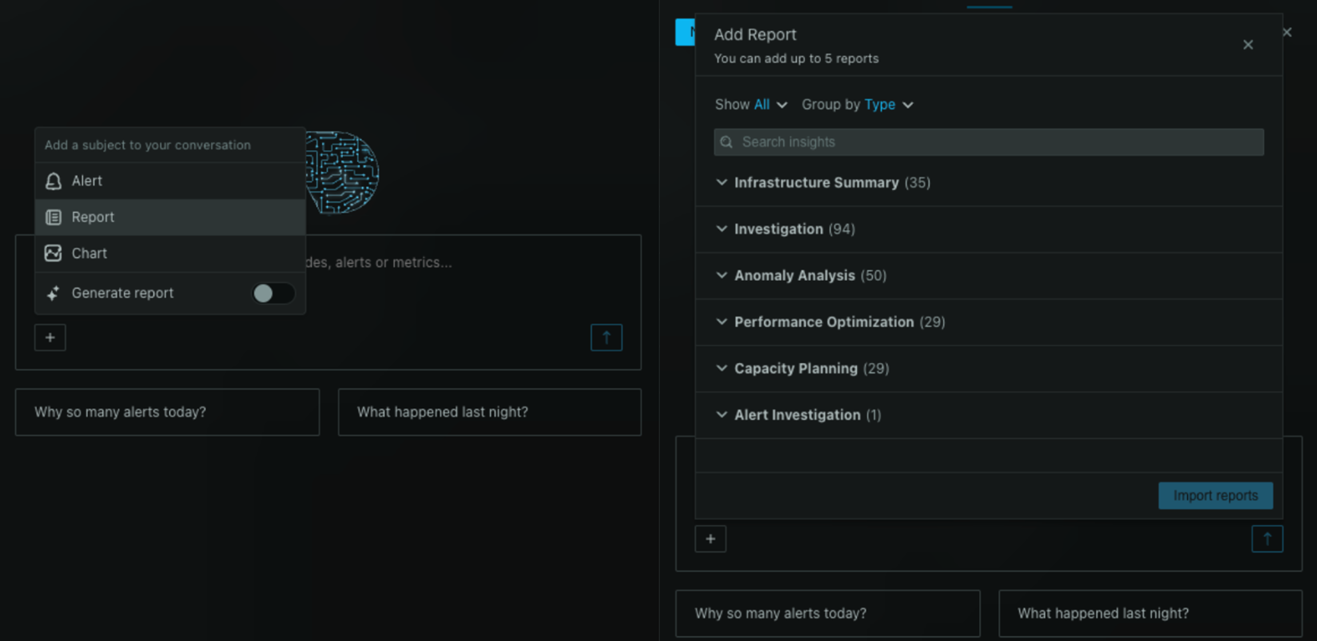
- Make sure you have a Business or Homelab plan on Netdata Cloud
- Generate an API token with
mcpscope from the Netdata Cloud UI - Point your AI assistant’s MCP configuration to
app.netdata.cloud/api/v1/mcp - Start asking questions about your infrastructure
It works with Claude Code, Claude Desktop, Codex, ChatGPT, Cursor, Windsurf, and any other MCP-compatible client. See the full setup guide for step-by-step configuration instructions for each client.
Infrastructure-Aware AI — From Chat to Code to Ops
This is where things get really interesting. Every category of AI tool gains a new superpower when connected to your infrastructure via MCP:
General-purpose assistants like ChatGPT, Claude, and Gemini become conversational ops partners. Ask them to summarize the health of your infrastructure, explain an alert spike, or draft an incident report from real data — no dashboards, no context-switching.
AI coding agents like Claude Code and Codex become infrastructure-aware. A developer debugging a slow endpoint in Claude Code can pull live metrics from the database node, check for anomalies on the application servers, and review recent alerts — all without leaving the terminal. Codex can autonomously investigate a production issue, correlating deployment timestamps with performance regressions across your fleet.
The shift is the same across all these tools: AI stops guessing about your infrastructure and starts knowing. It moves from “this code might cause high memory usage” to “this code is causing high memory usage on 3 of your 12 production nodes right now.”
See It Live — Join Our Webinar
Want to see the Cloud MCP Server in action? We’re hosting a live webinar on March 18, 2026 where we’ll demo real-time conversational troubleshooting, root cause analysis, and infrastructure exploration — all powered by MCP.
To be clear: the Agent-level MCP Server remains free and open-source, built into every Netdata Agent. If you’re running air-gapped infrastructure, doing local development, or simply prefer direct on-premises access — the Agent MCP is there for you.Use Agent MCP for local, direct access. Use Cloud MCP when you need to see the full picture.
We’re excited to see what you build with it.