











Netdata AI sees everything your infrastructure does: every metric, every anomaly, every alert. It does not see what your infrastructure is: which services matter, which host is supposed to run hot, who owns what, what your team considers normal. Without that context, “CPU at 91%” is just a finding. With it, it might be a machine doing exactly its job.
Two places to put it
Infrastructure Knowledge holds that context. The more you tell Netdata AI about your environment, the more accurate its answers get.
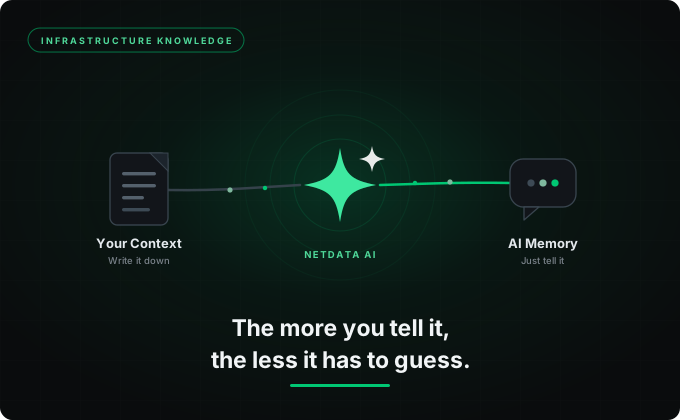
There are two ways to teach it, and they work together. You can write it down or just tell it; both live under Manage Space → Infrastructure Knowledge, in two tabs: Your Context and AI Memory.
Your Context: a document your team maintains
Your Context is a single Markdown document, shared across the Space, read at the start of every conversation, investigation, and report about your infrastructure.
The editor offers section templates to get you started:
- Infrastructure Overview: what you run and where, in a few paragraphs
- Service Tiers: which services are critical, which are best-effort, what’s worth waking someone up for
- Known Behaviours: patterns that look like problems but are normal, such as the nightly batch job, the ML node that always runs hot, the idle half of a blue-green deployment
- SLOs & Business Context: your targets, and what a breach means to the business
- Team Preferences: how you want findings presented, who to mention for what
- Upcoming Events: maintenance windows, migrations, expected load changes
- Architecture Notes: naming conventions, dependencies, anything that would trip up a newcomer
You don’t need to fill in everything. A few honest lines about what matters and what’s expected already change how Netdata AI reads your data. Skip anything Netdata can already see for itself (node lists, current values, running processes), and never put credentials or personal data in it.
Every save keeps a version, so you can review what changed and roll back at any time. You can also just ask Netdata AI to update it for you in a conversation, for example “Add the new Kafka cluster to my infrastructure context”, and it tells you what it changed.
AI Memory: what it’s learned from talking to your team
AI Memory is built simply by talking to it. Each memory is a single fact, shared with everyone in the Space, used in every future conversation, investigation, and report:
- “Remember that the 02:00 disk spike on backup-01 is expected.”
- “That alert is a false positive; the temp files get cleaned hourly.”
- “db-3 is the replica, not the primary.”
- “Keep investigation summaries short.”
Netdata AI tells you when it records something, so you can correct it while you still have the context. Say “don’t remember that” and it forgets; it may also offer to remember a correction you make while troubleshooting.
The AI Memory tab lists everything it has learned. You can read each one, delete what no longer applies, or clear them all.
How Netdata AI uses it
Context and memory are read before Netdata AI interprets anything. Your context explains what things mean; telemetry shows what is happening. It uses your knowledge to interpret the data, never to override it. If your document says a node was decommissioned and the node is still reporting, it tells you the two disagree rather than picking a side.
When your context changes a conclusion, it tells you where that came from: a node it didn’t flag because you marked it staging, a spike it called expected because you said so. When it needed context you haven’t given it yet, it says that too, so you know what to add next.
Availability
Infrastructure Knowledge is available on paid Netdata Cloud plans. Space admins, managers, and troubleshooters can edit it; observers can view it.
Getting started
Nothing to configure: open Manage Space → Infrastructure Knowledge and start with a few lines about what matters most, or just tell Netdata AI something true about your infrastructure the next time you’re in a conversation with it. Full documentation is on its way to learn.netdata.cloud.